Risk Leadership
Decision Quality Under Pressure
Pressure does not create standards. It reveals them. When the clock is compressed, information is incomplete, and consequences matter, leaders do not rise to a fantasy version of themselves. They fall back on the quality of their routines, judgment, evidence, and ownership.
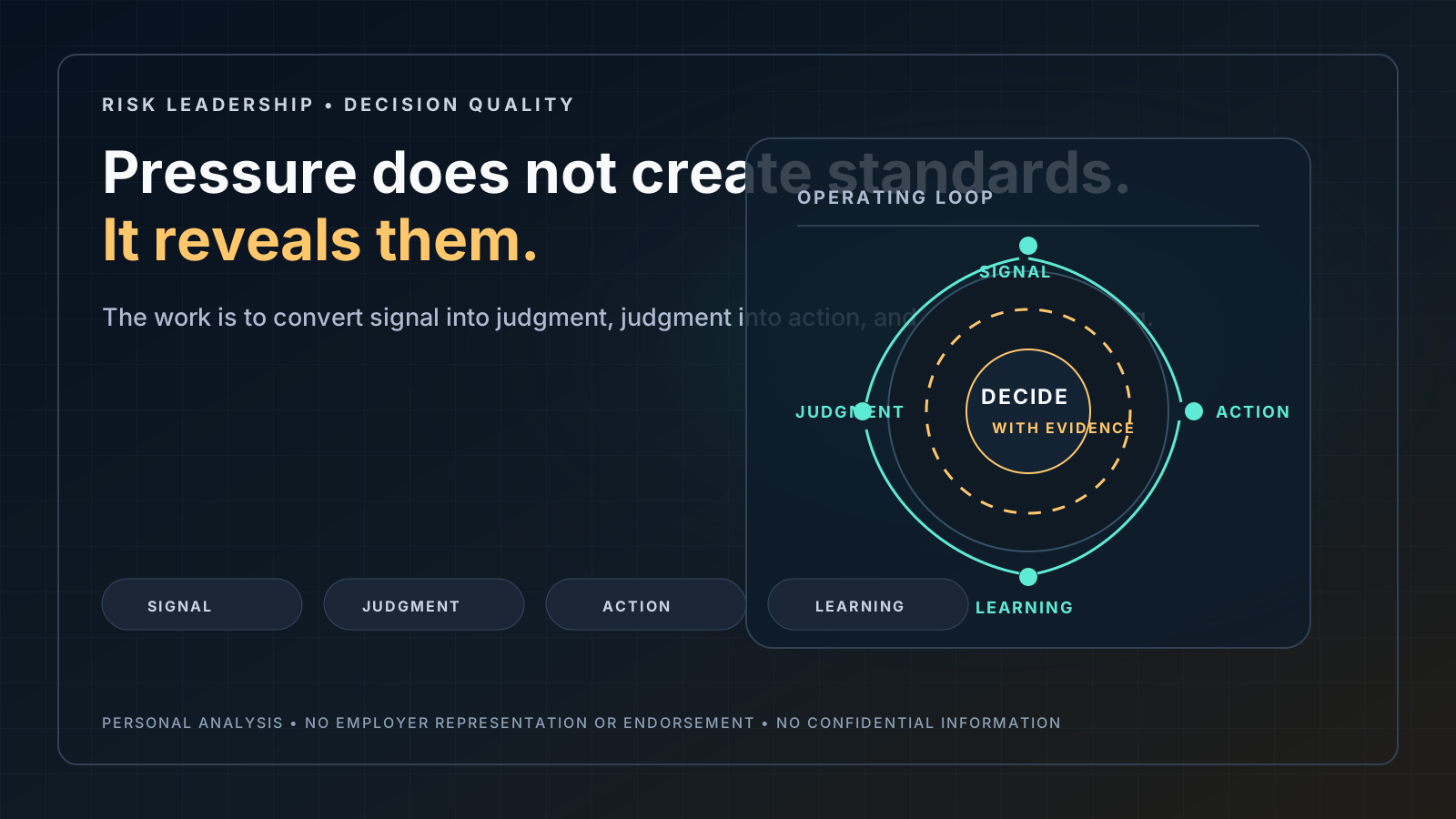
The leadership question is not whether pressure can be removed. It is whether pressure can be met with standards strong enough to keep judgment intact.
Signal Before Narrative
Weak signals rarely arrive as clean instructions. They arrive as friction, delay, inconsistency, rising dependency, quiet discomfort, or a small deviation that is easy to rationalize. Decision quality begins when leaders notice the signal before a convenient story forms around it.
In risk leadership, the first failure is often not the decision itself. It is the decision to ignore the signal because it is inconvenient, ambiguous, or politically uncomfortable.
Judgment Before Speed
Speed matters, but speed without judgment can turn uncertainty into exposure. The point is not to slow everything down. The point is to separate urgency from panic, material risk from noise, and evidence from preference.
Training disciplines reinforce this standard. Running, motorsport, tactical games, and professional risk work all punish sloppy attention. The environment changes, but the principle remains the same: composure is built before it is tested.
Action Before Drift
A good decision needs ownership. If no one owns the next action, the organization has not made a decision; it has created a discussion artifact. Under pressure, ambiguity around ownership becomes expensive.
Action does not always mean escalation, approval, or intervention. Sometimes it means pausing, narrowing scope, asking for evidence, setting a review point, or making a tradeoff explicit. But it must be named.
Learning Before Repetition
The strongest leaders do not treat outcomes as isolated events. They convert them into better standards. What did the signal look like? Where did judgment hold? Where did ownership blur? Which assumption became fragile under pressure?
Learning is not storytelling after the fact. It is the discipline of improving the operating model so the next decision starts from a stronger place.
The Standard
Decision quality is not perfection. It is the ability to see clearly enough, act responsibly enough, and learn honestly enough when pressure makes every weakness louder. That is where risk leadership becomes practical.